
Senior living campuses, especially those with independent living cottages or spread-out buildings, face unique connectivity challenges. Fixed Wireless offers a practical alternative.
Extending reliable internet across large outdoor areas or between detached structures can be costly, disruptive, and time-consuming when traditional fiber installation is required. By delivering internet connectivity wirelessly between buildings, Fixed Wireless allows senior living communities to expand coverage quickly and efficiently, without trenching, permits, or construction-related disruption.
What is Fixed Wireless and How Does It Work?
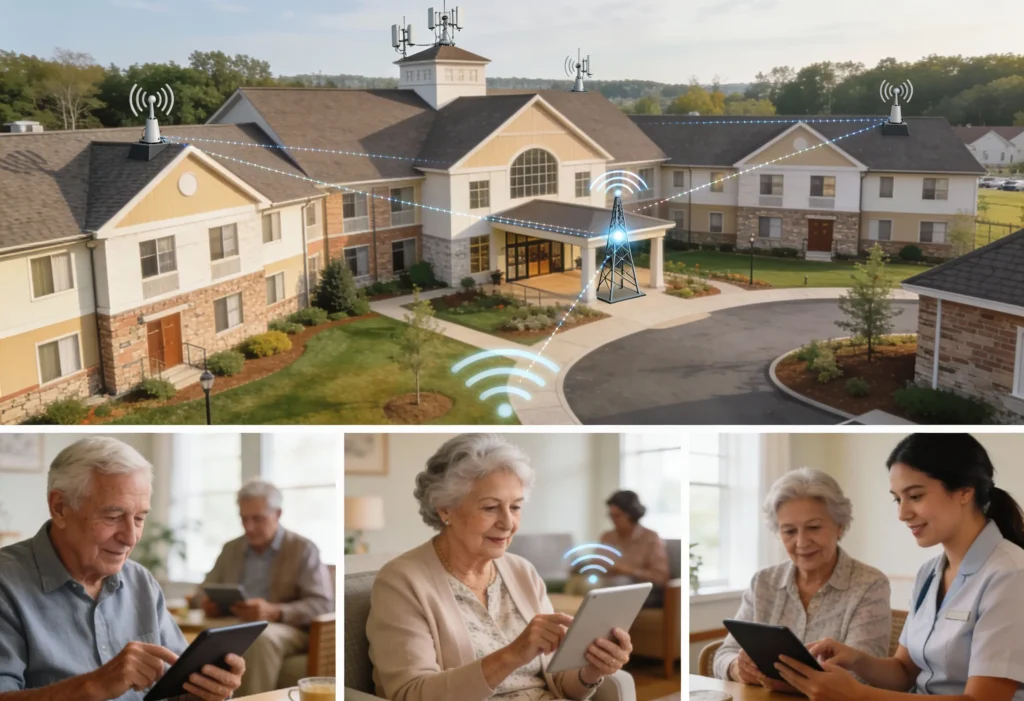
Fixed Wireless uses dedicated wireless links to deliver internet connectivity between buildings across a campus. Rather than relying on underground cabling, these links transmit data through the air between strategically placed access points.
For cottage-style senior living communities, this approach enables consistent connectivity to independent living units, shared amenities, and operational buildings without the complexity of extending fiber to every structure.
Supporting Resident Experience Across the Campus
Residents increasingly rely on dependable internet access for daily activities, including video calls with family, telehealth appointments, streaming entertainment, and online learning. In independent living cottages, inconsistent connectivity can quickly become a source of frustration.
Fixed Wireless helps deliver a more consistent experience by extending connectivity evenly across the campus. When paired with on-site distribution technologies such as Wi-Fi as a Service (WaaS), communities can provide reliable access inside individual living spaces while maintaining centralized control and management.
Enabling Staff Connectivity and Operational Systems
Beyond resident use, senior living operations depend on connectivity for clinical systems, staff communications, and building technologies. Fixed Wireless supports campus-wide access to systems such as EMR/EHR platforms, access control, surveillance, and building management tools.
In environments where fiber may be impractical or delayed, Fixed Wireless can also complement Direct Internet Access (DIA) by extending primary connectivity from a central network core to remote buildings across the property.
Cost, Speed, and Deployment Advantages of Fixed Wireless
Installing fiber across large or developed campuses often requires excavation, permits, and coordination that can disrupt daily life for residents. Fixed Wireless avoids much of this complexity by leveraging above-ground deployment.
This makes it particularly attractive for communities looking to expand connectivity quickly, support phased growth, or connect new cottages without major infrastructure projects. It also allows campuses to scale more easily as needs evolve.
Fixed Wireless as Part of a Broader Connectivity Strategy
Fixed Wireless is not a replacement for every connectivity solution, but it plays an important role in a layered network strategy. While it supports everyday operational and resident connectivity, other systems address different, equally important requirements.
For example, Cellular Boost solutions help ensure reliable mobile coverage inside buildings where cellular signals struggle to penetrate, supporting staff, residents, and visitors who rely on mobile devices.
Separately, Emergency Responder Communication Enhancement Systems (ERCES) address life safety requirements by ensuring first responders can communicate clearly inside buildings during emergencies; an essential but distinct consideration from day-to-day internet access.
Designed for Growth, Resilience, and Flexibility
Senior living communities evolve over time. New cottages are added, technology demands increase, and operational systems become more connected. Fixed Wireless supports this evolution by providing a flexible way to extend connectivity without locking facilities into rigid infrastructure decisions.
By integrating Fixed Wireless with fiber-based services, in-building Wi-Fi, cellular enhancement, and life safety systems, communities can build a resilient connectivity foundation that supports both current needs and future expansion.
A Practical Choice for Modern Senior Living Campuses
Fixed Wireless offers senior living operators a cost-effective, scalable way to deliver reliable connectivity across complex campuses. Especially in cottage-style environments, it reduces disruption while improving access for residents, staff, and essential systems.
When implemented as part of a broader connectivity strategy, Fixed Wireless helps communities balance performance, flexibility, and long-term planning, without unnecessary complexity. Visit the HealthSignals website to find out more.